Why Dance Belongs at Celebrations
Celebrations are created for moments that are worth remembering. There's a transition, a change, a renewal, a statement of support, during childbirth, marriage, harvest, religious festival, or community event, all requiring something more extensive than speech. Dance-like gestures, of joining in and spontaneous movement, allow a collective expression of emotion and symbolism with few apparatuses for formal explanation or structured innards.
Movement as Shared Expression
At celebrations, dance functions as a form of shared expression rather than individual performance. The value lies not in how well someone dances, but in the act of moving together. Simple steps, repeated patterns, and familiar rhythms allow wide participation, lowering barriers and reducing self-consciousness.
This shared movement creates a sense of unity. When bodies move in time, attention shifts away from individual differences toward collective presence. People become aware of one another through rhythm and proximity, reinforcing social connection without the need for conversation or coordination.
Emotion Made Visible
Celebrations often involve emotions that are difficult to contain or articulate, such as joy, relief, pride, gratitude, or collective excitement. Dance gives these feelings a physical outlet. Changes in energy, tempo, and intensity allow emotion to be released safely and communally.
Because emotion is expressed through the body rather than words, it becomes visible and shared. Participants recognize their own feelings reflected in others’ movements, expressions, and responsiveness. This recognition strengthens empathy and deepens emotional bonding within the group.
Marking Time and Transition
Many celebrations are tied to moments of change. Dance helps mark these transitions by creating a clear break from ordinary time. Stepping into dance signals that something significant is happening, separating the celebratory moment from daily routine.
This shift in time and atmosphere helps participants internalize the importance of the occasion. Movement, music, and shared rhythm make the moment memorable, anchoring it in physical experience and making the memory more durable over time.
Dance in Weddings and Life Milestones
Weddings are the ideal time to engage in social dances across cultures. They are new beginnings, not just for the bride, groom, families, and friend community. Dance, therefore, is a key player in showing this transition to new relationships and changing social roles, and it offers everyone a common ground where they can partake in acknowledging that change.
Celebrating Union and Belonging
In wedding contexts, dance often symbolizes union. The act of dancing together reflects partnership, cooperation, and shared rhythm. When families and guests join the dance, the union expands beyond the couple, reinforcing bonds between groups.
Group dances, circles, or line formations emphasize inclusion. They visually represent the idea that the marriage is supported by and embedded within a wider community, rather than existing as an isolated relationship.
Intergenerational Participation
Social celebration dances often include participants of all ages. Children, adults, and elders may dance side by side, each contributing according to ability and comfort. There is rarely an expectation that everyone moves in the same way or with the same energy.
This intergenerational participation reinforces continuity. It allows cultural practices to be observed, absorbed, and adapted naturally, ensuring that dance remains a living part of social life rather than a formal tradition removed from everyday experience.
Ritualized Moments Within Celebration
Many celebrations include specific dance moments that carry symbolic meaning, such as a first dance, a communal opening, or a closing movement that signals completion. These moments act as anchors within the event, giving structure and emphasis.
Even when adapted, simplified, or personalized, these ritualized dances help participants understand the progression and significance of the celebration. They provide points of focus that organize shared attention and memory.
Festivals and Collective Identity
Festivals bring together large groups to celebrate shared identity, history, or seasonal cycles. Dance is central to these gatherings because it provides a visible and participatory expression of collective belonging. It allows individuals to experience themselves as part of something larger.
Dance as Public Participation
Unlike staged performances, festival dances often invite participation from anyone present. The boundary between dancer and observer becomes fluid, emphasizing that celebration is something to be joined rather than watched.
This openness strengthens community ties. Participation signals inclusion, while shared movement fosters familiarity and trust among participants who may not interact regularly outside the festival context.
Symbolism and Cultural Reference
Festival dances often carry symbolic gestures, formations, or rhythms that reference shared stories, values, or environmental cycles. These symbols are not always explicitly explained, but they are learned through repetition and context.
Over time, participants associate certain movements with particular meanings, reinforcing cultural memory through embodied experience rather than formal instruction.
Repetition and Annual Rhythm
Many festivals occur on regular cycles, such as annually or seasonally. Repeating dances at these intervals reinforces a sense of rhythm in communal life, creating continuity across years.
The familiarity of returning dances creates anticipation and comfort. It links past celebrations with present ones, strengthening long-term collective memory and reinforcing a shared sense of time.
Community Gatherings and Informal Celebrations
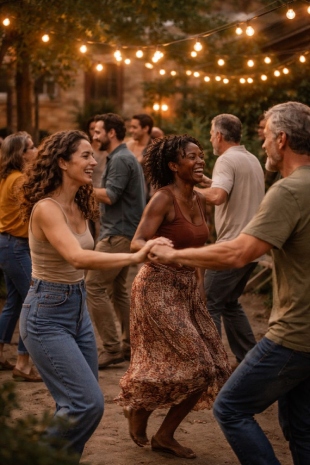
Not all social celebrations come in a formal or large-scale format. In the events or gatherings that are organized in communities, neighborhoods, or in informal landmark settings, people enjoy dance to be together. Dance commonly evolves in such gatherings on its own accord.
Accessibility Over Skill
Informal celebration dances prioritize accessibility. Simple movements, familiar rhythms, and relaxed expectations encourage participation regardless of experience or confidence.
This emphasis reduces self-consciousness and shifts focus away from performance. What matters is presence and willingness to join, not technical ability or correctness.
Strengthening Social Bonds
Dancing together in informal settings strengthens relationships through shared enjoyment. Laughter, improvisation, and mutual responsiveness create positive associations and build trust.
These shared experiences contribute to social cohesion, reinforcing connections that often extend beyond the event itself into everyday interaction.
Spontaneity and Collective Energy
Unlike formal rituals, informal dances often respond directly to the moment. Changes in music, mood, or group dynamics influence how the dance unfolds.
This spontaneity reinforces the idea that dance is a living response to social energy rather than a fixed structure, keeping celebration dynamic and engaging.
Symbolism and Meaning in Social Dance
Even though seemingly soft and frivolous dances usually epitomize a lot of importance in meaning. Grotesque postures, formations, and rhythms talk about societal issues about relationship, balance, and group identity. Often these meanings may not find any articulate explanation; however, they pick up some significance through participation and repetition.
Circles, Lines, and Shared Space
Common formations such as circles and lines emphasize equality and connection. Circles remove hierarchy, placing participants in shared relation, while lines encourage synchronized movement and cooperation.
The use of shared space reinforces the idea that celebration is collective, with no single focal point dominating attention.
Call and Response
Many social dances include call-and-response elements, whether through movement, rhythm, or vocal cues. These exchanges create dialogue within the group, reinforcing attentiveness and mutual awareness.
Call-and-response structures encourage active engagement, making participation dynamic rather than passive.
Repetition as Reinforcement
Repetition plays a key role in social dance. Repeating steps or sequences allows participants to settle into the movement, reducing uncertainty and increasing comfort.
This repetition reinforces shared experience, making the dance feel familiar even to newcomers and strengthening collective rhythm.
Dance, Memory, and Shared Experience
Dance plays a powerful role in how celebrations are remembered. Physical movement anchors memory in the body, making experiences more vivid and lasting than words alone.
When people recall celebrations, they often remember how they moved and felt rather than specific details or sequences of events.
Embodied Memory
Movement creates embodied memory. The sensation of dancing, the rhythm of music, and the proximity of others leave physical impressions that persist beyond the event.
These memories are often triggered by music or movement long after the celebration, reconnecting individuals to shared experience.
Emotional Association
Because dance is closely tied to emotion, memories of celebration often carry strong emotional resonance. Joy, connection, and release experienced through dance become inseparable from the memory itself.
This emotional association strengthens bonds between participants and reinforces positive collective identity.
Stories Passed Through Experience
Over a period of time, the dances that marked a celebration tell their own stories. People remember who danced, the feel of the event, and its significance. These stories are transmitted informally through collective memories by following oral tradition. This strengthens a general continuity over time without any formal documentation.
Dance as Social Glue
Across cultures and contexts, dance functions as social glue during celebrations. It brings people together physically and emotionally, reinforcing relationships and shared identity.
Its power lies not in precision or spectacle, but in participation and presence.
Reducing Social Barriers
Dance temporarily softens social boundaries. Differences in age, status, or background become less pronounced when people move together in shared rhythm.
This reduction of barriers supports inclusion and mutual recognition within the group.
Creating Belonging Through Participation
Participation in dance signals belonging. Joining the movement affirms connection to the group and acceptance within the social space.
This sense of belonging is especially important during milestones that reshape social relationships.
Celebration as Collective Experience
Dance reinforces the idea that celebration is not something witnessed, but something lived together. Meaning emerges through shared action rather than observation.
This collective experience strengthens communities and ensures that celebrations remain meaningful beyond their symbolic purpose.
Why Dance Continues to Matter in Social Celebrations
Despite changes in technology, culture, and social structure, dance remains central to celebration because it meets fundamental human needs. It allows people to connect, express emotion, and mark significance without reliance on language or formal ritual.
Dance adapts easily to different settings, making it resilient across time and cultures.
A Shared Language of Celebration
Dance has its place in social events chiefly because it is a human heritage. Dance turns feelings to traditions; makes individuals into communities and moments into shared social memory. Dance is interwoven into the fabric of every marriage, celebration, or even daily gathering.